
Table of Contents
- What you’ll learn in this interview
- Why you should use a specialist lawyer for rural property in Spain
- The legal searches your lawyer should carry out
- Escritura vs nota simple vs catastro
- Tourism licences for rural homes in Andalusia
- About Antonio Manzanares and Manzanares Lawyers
- Watch the Interview
- Useful Links
- FAQs
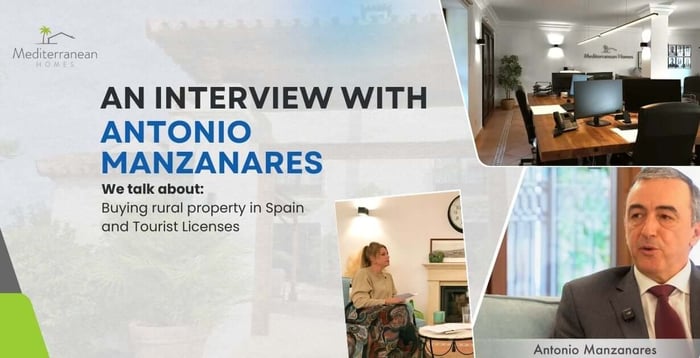
If you’re considering a move inland to the stunning Guadalhorce Valley and exploring fincas for sale on the Costa del Sol, the legal side of buying a country property can feel daunting at first. In this interview, hosted by Mediterranean Homes Director Kelly Summerell, local legal expert Antonio Manzanares of Manzanares Lawyers explains why it’s essential to work with a lawyer who specialises in rural property in Spain, the key legal searches involved, and what you need to know about obtaining a tourism licence in Andalusia.
What you’ll learn in this interview
- Why rural conveyancing needs specialist knowledge (especially for country land and outbuildings)
- The core legal searches used to verify ownership, restrictions, and compliance
- The practical difference between escritura, nota simple, and catastro
- How applying for a tourism licence in Andalusia works for rural homes, typical timescales, and what happens when the property is sold
Why you should use a specialist lawyer for rural property in Spain
Antonio’s message is simple: when you’re making a major investment in a rural property in Spain, you want full guarantees from the start of the transaction to the end. A specialist lawyer supports you from the reservation stage, through due diligence and completion, and then through post-completion registration.
That matters because issues in rural purchases can be easy to miss until it’s too late: registration gaps, discrepancies between records, supply documentation, or restrictions that affect what you can do with the property.
The legal searches your lawyer should carry out
When buyers ask us about fincas for sale on the Costa del Sol, this is the type of due diligence Antonio describes. In the interview, he explains that his team checks multiple sources to confirm the property is correct on paper and ready to complete.
- Land Registry (including an updated nota simple to confirm current legal status)
- Escritura / title deed (the notary-signed document describing the transaction and the property)
- Town Hall records (relevant local checks)
- Catastro (tax record for mapping and property description, including plot and built sizes)
- Utilities (electricity and water supply situation)
- Community (comunidad) involvement, where applicable
If something isn’t fully correct, Antonio explains it should be addressed before completion, so the buyer proceeds with confidence and peace of mind.
Escritura vs nota simple vs catastro
Confusion between these terms is common when buying rural property in Spain. Antonio breaks it down clearly:
- Escritura (title deed): the notary-signed document recording the buyer, seller, and property description. This must then be registered at the Land Registry.
- Nota simple: an up-to-date Land Registry report showing ownership and the property’s legal situation at that moment. Antonio describes this as essential because it can reveal mortgages, charges, embargoes, or other limitations.
- Catastro: a tax authority record used for local taxes (such as IBI). It focuses on the physical description (location/map/plot size/built size), and it is not a register of ownership.
Tourism licences for rural homes in Andalusia
Many buyers considering buying a finca on the Costa del Sol want flexibility: personal use plus holiday rentals. In the interview, Antonio explains that the process to obtain a Tourist License can be straightforward... when the documentation is prepared properly!
There are two rural licence types
- Casa Rural: accommodation plus additional services (examples given: breakfast, organised experiences, activities)
- Vivienda Turística Rural: accommodation only
Timescale and cost
Antonio explains that once the required documentation is ready and submitted, a tourism licence for a rural property can be in place in around two weeks. He also notes an approximate legal fee of €600 for managing the process from start to finish (depending on the property and requirements).
Does the tourism licence need renewing?
According to Antonio, once granted, the licence has no time limit. It is linked to the property.
What happens if the property is sold?
Antonio explains that a recent resolution clarified the position: the tourism licence is linked to the property, so if a buyer purchases a home with an existing licence, they don’t start from zero. Instead, they notify the administration of the change of ownership so the licence details are updated.

About Antonio Manzanares and Manzanares Lawyers
Antonio Manzanares is a partner and Executive Director at Manzanares Lawyers. The firm was founded in Alhaurín el Grande and has been advising clients for over two decades, including property conveyancing matters for inland and coastal areas. Their work focuses on guiding clients through Spanish legal processes with clear communication and thorough due diligence, particularly important when purchasing a rural property in Spain.
If you’re considering purchasing a finca in the Guadalhorce Valley and want to rent legally, understanding the due diligence and the tourism licence Andalusia process from the start can save time, cost, and stress later on.
Watch the Interview
Interview Transcript
Kelly Summerell: Hello. Today we have Antonio Manzanares with us. Antonio is one of the partners and Executive Director of Manzanares Lawyers in Alhaurín el Grande. Antonio, thank you very much for taking the time and being here today. It’s a pleasure having you.
Antonio Manzanares: Thank you very much for the invitation.
Kelly Summerell: Antonio, can you give us a little bit of information about you, your experience, and what it is that you do exactly?
Antonio: Manzanares Lawyers was founded in Alhaurín el Grande 27 years ago. We’ve been offering services in Alhaurín el Grande and later started offering services in Marbella as well. We have more than 25 years of experience helping clients.
Kelly Summerell: Why is it so important for buyers or sellers to use a solicitor when purchasing or selling a property?
Antonio: For me it is essential. When you are doing a big investment and you are putting a lot of money into buying or selling a property, you need total guarantees from the beginning to the end. We offer services from the beginning to the end. We are involved with the reservation document when the property is taken off the market. After that we do specific legal searches for the property. We check the Land Registry, the escritura, the Town Hall, the Catastro, electricity supply, water supply, and whether there is any community involved. We check all of that to confirm everything is correct. If something is not correct, it needs to be solved before completion. On completion we ensure everything is done with guarantees, and afterwards we register all documentation to confirm it is perfectly done. This gives peace of mind.
Kelly Summerell: There is a lot of confusion between the difference between nota simple, escritura, and catastro. Can you explain the difference?
Antonio: The escritura is the title deed. It mentions who is the seller, who is the buyer, and the description of the property. It is signed at the notary office. That escritura must be registered at the Land Registry. Once registered, we can obtain the nota simple. The nota simple is a report from the Land Registry about the situation of the property on that date. It must be updated; we cannot rely on a nota simple produced years ago. We need a current one to know the situation now.
Antonio: The catastro is part of the tax office. It is used by the Town Hall to calculate local taxes paid annually (such as IBI). The catastro is not a registry of ownership; it is a registry of the description of the property: location, maps, plot size, built size. It does not show mortgages or charges. The Land Registry and nota simple confirm ownership and any mortgage, embargo, or limitation.
Kelly Summerell: How easy is it to obtain a tourism licence on a country property in Andalusia?
Antonio: The regulation for tourist activity in urban areas (apartments) is different from rural properties. For the countryside, the procedure is simple and it is done through the Junta de Andalucía. Depending on the activity, there are mainly two types of licences. One is Casa Rural: accommodation plus extra services such as breakfast, tours, experiences, and activities. The other is Vivienda Turística Rural, where you offer accommodation only.
Antonio: We prepare the documentation confirming ownership, registration, and capacity (for example, two bedrooms means accommodation for four people). We submit everything to the Junta and in approximately two weeks the licence can be in place, so you can start operating. The cost depends on the property, but we typically charge around €600 for the process from beginning to end.
Kelly Summerell: Does the licence need to be renewed?
Antonio: No. Once you have it, there is no time limit. It is linked to the property.
Kelly Summerell: If the property is sold, does the tourism licence stay with the property?
Antonio: Yes. There was some interpretation in the past, but now it is clear: the tourist licence is linked to the property. If I buy a property with a licence in place, I don’t start from zero. I communicate the change of ownership to the Junta, and the licence is updated to the new owner’s name. It is a straightforward procedure.
Kelly Summerell: Antonio, thank you very much for being here today.
Antonio: Thank you very much for the invitation.
Useful Links
How to apply for a Tourism License yourself in Andalusia
Selling Your Property with Mediterranean Homes
FAQs
Is it safe to buy rural property on the Costa del Sol?
Yes, it can be very safe, but only if proper legal checks are carried out. Buyers should ensure the property is correctly registered, has an up-to-date nota simple, and that any buildings are legally recognised before completing the purchase.
What legal checks are needed when buying a finca in Spain?
Key checks include the Land Registry (nota simple), title deed (escritura), Town Hall records, Catastro details, utility supply legality, and confirmation of any mortgages, embargoes, or planning restrictions affecting the property.
Can you get a tourism licence for a rural property on the Costa del Sol?
Yes. Many rural properties can obtain a tourism licence in Andalusia, often through a simpler process than urban apartments. The type of licence depends on whether accommodation only or additional services are offered.
What is the difference between a finca and a rural villa in Spain?
A finca is typically a countryside property that may include land used for agriculture or leisure, while a rural villa is often a residential home in a non-urban area. Legal status and usage rights can vary, so due diligence is essential.
Are there extra costs when buying rural property in Spain?
Yes. In addition to the purchase price, buyers should budget for taxes, notary fees, Land Registry fees, legal fees, and potential costs to regularise or update property documentation if issues are discovered during legal searches.
How do I obtain a tourist licence for a rural property in Andalusia?
To obtain a tourist licence in Andalusia for a rural property, the owner must submit documentation confirming ownership, registration, and guest capacity to the regional authority (Junta de Andalucía). Once approved, the licence allows the property to be legally rented to holiday guests.
What type of tourist licence do I need for a finca in Spain?
The licence depends on how the property will be used. A Vivienda Turística Rural allows accommodation only, while a Casa Rural licence permits accommodation plus additional services such as breakfast, activities, or organised experiences.
How long does it take to get a tourist licence for a rural finca?
When all documentation is correct and complete, a tourist licence for a rural property in Andalusia can often be issued within two to three weeks. Delays usually occur if documents are missing or require correction.
Does a tourist licence in Andalusia expire or need renewing?
No. Once issued, a tourist licence in Andalusia does not expire. It remains valid unless there is a significant change to the property or its permitted use.
Can a tourist licence be transferred when a rural property is sold?
Yes. Current regulations confirm that the tourist licence is linked to the property, not the owner. When a finca with an existing licence is sold, the new owner simply notifies the authorities of the change of ownership rather than applying for a new licence.